
NaviFUS Clinical Trial Published in Epilepsia
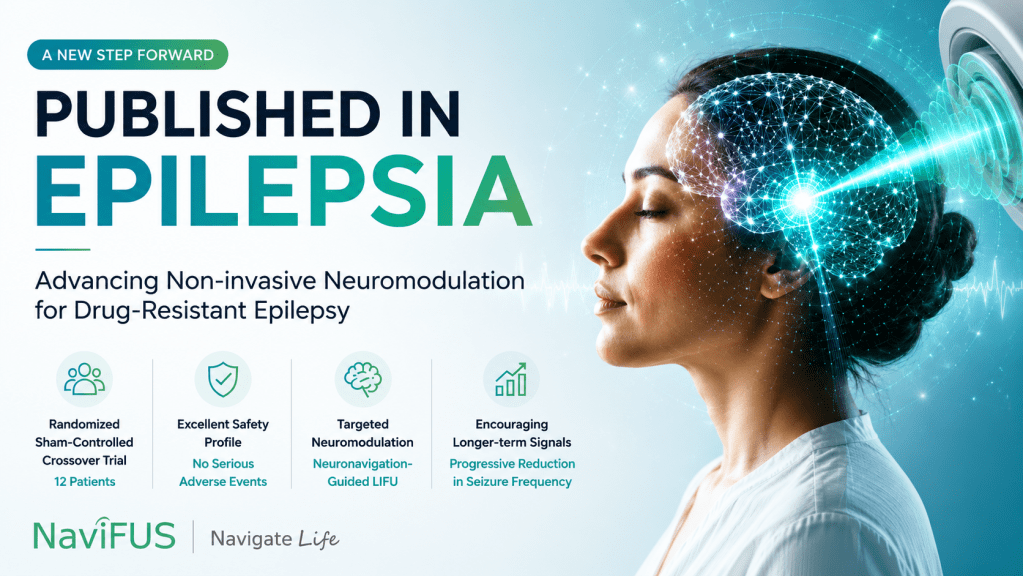
First randomized, sham-controlled crossover trial provides preliminary safety and clinical feasibility evidence, with exploratory signals of progressive seizure reduction during extended follow-up.
TAIPEI, Taiwan — August 10, 2026 — For people living with drug-resistant epilepsy, seizures can remain uncontrolled despite multiple anti-seizure medications, with long-term effects on daily life, work, relationships, and families. A newly published study in Epilepsia adds important clinical evidence for precise brain neuromodulation without surgery or implanted devices.
NaviFUS Corporation announced the online publication of “Low-intensity focused ultrasound neuromodulation for drug-resistant epilepsy: A randomized, sham-controlled crossover trial.” Conducted at Taipei Veterans General Hospital, the pilot, single-blind study enrolled 12 adults with drug-resistant epilepsy. Each participant completed both low-intensity focused ultrasound (LIFU) and sham treatment, allowing the study to evaluate individualized targeting, preliminary safety, clinical feasibility, and efficacy signals.
| Key Study Highlights • First randomized, sham-controlled crossover trial: 12 adults with drug-resistant epilepsy completed both LIFU and sham treatment, allowing each participant to serve as their own control and strengthening the rigor of early clinical evaluation. • Precise, non-invasive targeting: Treatment planning accounted for skull-induced acoustic attenuation and refraction; neuronavigation-guided LIFU targeted each participant’s seizure onset zone. • Favorable safety and tolerability: No serious adverse events were observed, and post-treatment MRI showed no structural brain injury. • Encouraging longer-term signals: After all participants had received LIFU, seizure frequency showed a progressive downward trend during extended follow-up, suggesting a potentially time-dependent neuromodulatory response that warrants further study. |
Clinical Findings
Individualized Targeting, Preliminary Safety, and Clinical Feasibility
Precision and feasibility: The study combined neuronavigation, patient-specific skull modeling, and acoustic simulation to target
Precision and feasibility: The study combined neuronavigation, patient-specific skull modeling, and acoustic simulation to target each participant’s seizure onset zone. Targets ranged from approximately 31 to 98 mm beneath the scalp. System output was adjusted for individual skull characteristics to keep the estimated intracranial focal energy within a relatively concentrated range. Post-treatment acoustic analysis quantified attenuation, beam deformation, and focal displacement, providing data to further improve targeting consistency.
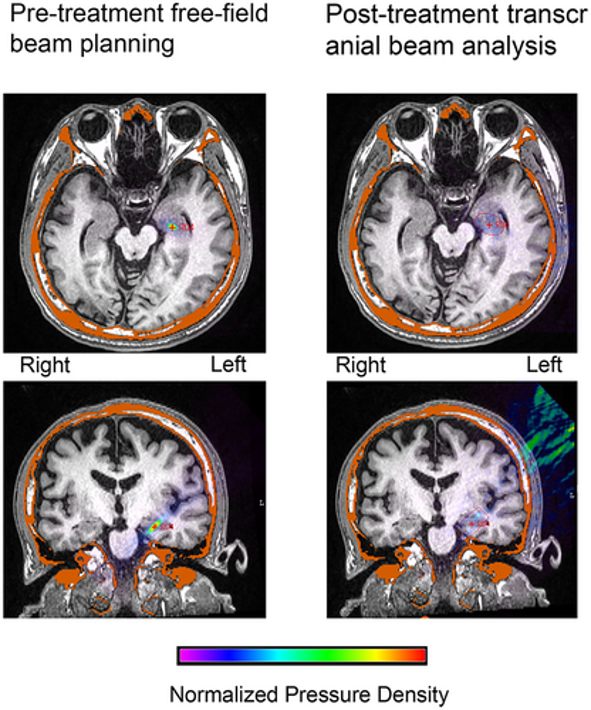
Research used each participant’s skull imaging, neuronavigation, and acoustic simulation to plan the treatment trajectory. Post-treatment analysis quantified energy attenuation, beam deformation, and focal displacement after transmission through the skull to characterize the acoustic field delivered to the target brain region. Source: Chou et al., Epilepsia (2026), CC BY.
Preliminary safety and tolerability: No serious adverse events occurred. Structural brain MRI two weeks after treatment showed no tissue injury at the treatment targets. Treatment-related discomforts were transient and required no additional medical intervention. Anxiety, depression, and quality-of-life measures showed no significant differences between LIFU and sham.
Short-term responses varied; extended follow-up showed a progressive signal: During the randomized crossover phase, seizure frequency showed marked individual variability and temporal fluctuation. After all participants had received LIFU, mean seizure frequency in both treatment sequences was generally below baseline during extended follow-up. Longitudinal analysis showed an average decrease of 14 percentage points per month. Because the extension phase was not sham-controlled, this potential delayed neuromodulatory signal requires confirmation in a larger parallel-group randomized trial.
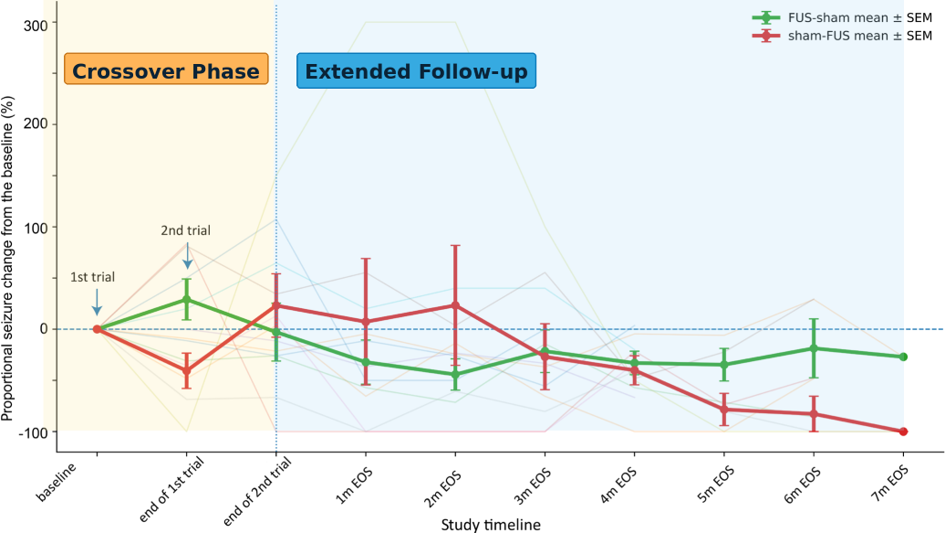
Figure | Changes in seizure frequency across the crossover trial and extended follow-up by treatment sequence. Green: LIFU followed by sham. Red: sham followed by LIFU. Short-term responses showed individual variability and temporal fluctuation; after all participants had received LIFU, extended follow-up showed an exploratory progressive downward signal. Source: Chou et al., Epilepsia (2026), CC BY.
A New Direction for Non-Invasive Epilepsy Care
Approximately one-third of people with epilepsy continue to experience seizures despite medication. Existing neuromodulation treatments—including vagus nerve stimulation (VNS), deep brain stimulation (DBS), and responsive neurostimulation (RNS)—typically require surgical implantation of electrodes or stimulators. LIFU offers a different path: acoustic energy can pass through the skull and precisely target a selected brain region without an incision or implanted device.
This study adds important randomized, sham-controlled safety evidence and further supports the clinical feasibility of neuronavigation-guided focused ultrasound for drug-resistant epilepsy. Future trials will require larger patient populations, longer observation, and continued optimization of treatment schedules, acoustic parameters, target coverage, and targeting accuracy to confirm efficacy and identify the patients most likely to benefit.
The study was led by Taipei Veterans General Hospital with National Yang Ming Chiao Tung University and National Taiwan University, with support from NaviFUS Corporation and Taiwan’s National Health Research Institutes. NaviFUS sincerely thanks the patients, clinicians, investigators, and research teams whose participation made this work possible. Each rigorous clinical validation brings precise, non-invasive, lower-burden brain treatment one step closer to real-world clinical application.
Publication
Low-intensity focused ultrasound neuromodulation for drug-resistant epilepsy: A randomized, sham-controlled crossover trial
Epilepsia (2026) | DOI: 10.1002/epi.70404
Read the full publication: https://onlinelibrary.wiley.com/doi/full/10.1002/epi.70404