Key Points:
-Researchers in Taiwan completed an early-stage trial showing focused ultrasound–mediated blood-brain barrier opening plus chemotherapy is safe in patients with GBM.
– The investigators are now recruiting participants for a larger clinical trial with the same device – the NaviFUS system – at two sites.

Taipei, Taiwan – November 25, 2025 – At the 8th Asian–Oceanian Congress of Clinical Neurophysiology (AOCCN 2025) in Taipei, NaviFUS Corp. (6872) announced encouraging early clinical data showing that its neuronavigation-guided focused ultrasound (FUS) system is expanding beyond epilepsy into the field of stroke rehabilitation.
Genovate Biotechnology and NaviFUS Corporation have completed the first cohort of an investigator-initiated pilot study at Alfred Hospital in Australia, using the NaviFUS neuronavigation-guided focused ultrasound system in patients with drug-resistant epilepsy (DRE).
An independent Safety Monitoring Committee confirmed a favorable safety profile with no major safety concerns and recommended moving to the next cohort with additional treatment sessions.
Early results are encouraging, with most participants showing fewer seizure days and lower seizure frequency, including some with >80% reduction from baseline.
NaviFUS Corps. (6872) announced that the U.S. clinical trial of its NaviFUS® focused ultrasound system for drug-resistant epilepsy (DRE), led by Stanford University successfully completed treatment of its first patient at the middle of Aug. The trial is expected to finish enrollment of all six participants in the first half of next year.
Key Points:
-The study is testing NaviFUS’s neuronavigation-guided focused ultrasound system for treating patients with drug-resistant epilepsy.
-Up to 18 participants will be treated in Melbourne.
NaviFUS Corp. is revolutionizing brain disorder treatments through ultrasound-based solutions, leveraging Taiwan’s advanced chip technology. By integrating ICT capabilities into high-end medical devices, NaviFUS enhances signal processing beyond traditional medical devices, positioning itself as a global leader in focused ultrasound treatments.

In April, NaviFUS entered into a cooperation agreement with Bracco, a global leader in ultrasound imaging agents, to enhance the NaviFUS® System’s capability to open the blood-brain barrier (BBB) for the treatment of brain cancers and neurological diseases. This year, the system will be tested in several clinical trials, marking a significant advancement in non-invasive therapies.
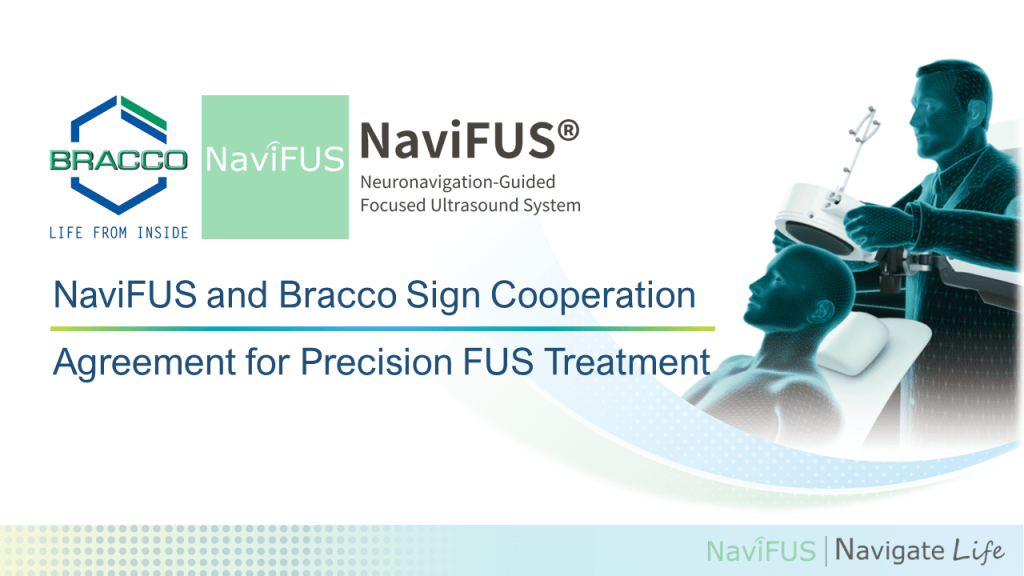
NaviFUS (6872) and Bracco, the world’s leading brand of ultrasound imaging agents, officially signed a cooperation agreement recently (4/26). Bracco will provide its microbubble imaging agents as part of the NaviFUS system’s treatment to open the blood-brain barrier (BBB). As a technology platform, the NaviFUS System will be used in clinical trials of various brain cancers or neurological diseases and registrations for the treatment. It is expected that after obtaining the marketing authorization, Bracco will be responsible for supplying this microbubble OEM product and authorize NaviFUS to bundle it as a medical device consumable with its device for acoustic therapy sales.

“Queen of Tears,” a recent popular Netflix K-Drama has been captivating global audiences with the tumultuous romance between its two main leads. It also happens to feature a look into some real innovative medical advancements in the treatment of brain tumors. The focused ultrasound treatment Hong Hae-in (Kim Ji-won) receives for her glioblastoma has been utilized in Taiwanese medtech firm NaviFUS’ clinical trials for the last few years and highlights Taiwan’s role as a leader in focused ultrasound advancements for the treatment of brain cancer.
Key Points:
– A new clinical trial is investigating sonodynamic therapy for patients with recurrent glioblastoma.
– This is the first clinical trial in the US to use the NaviFUS device, which combines neuronavigation with a mobile, noninvasive focused ultrasound system.
