
NaviFUS Featured in the 2026 FUS-PULSE White Paper: From Clinical Use to the Next Stage of Focused Ultrasound
Two years can change a field.
At the first FUS-PULSE meeting in 2024, much of the conversation focused on what focused ultrasound might achieve in psychiatry. In the newly released 2026 FUS-PULSE white paper, the conversation has clearly shifted: the field is now discussing clinical data, safety, new device platforms, and how focused ultrasound can move toward broader real-world use.
For NaviFUS, that shift is especially meaningful. The white paper includes NaviFUS in discussions of clinical use, safety, image-guided workflow, and acoustic targeting.
Clinical Experience and Workflow
During the session on focused ultrasound neuromodulation for addiction, Ali Rezai, MD, Executive Chair of the WVU Rockefeller Neuroscience Institute (RNI), presented clinical experience across focused ultrasound platforms.
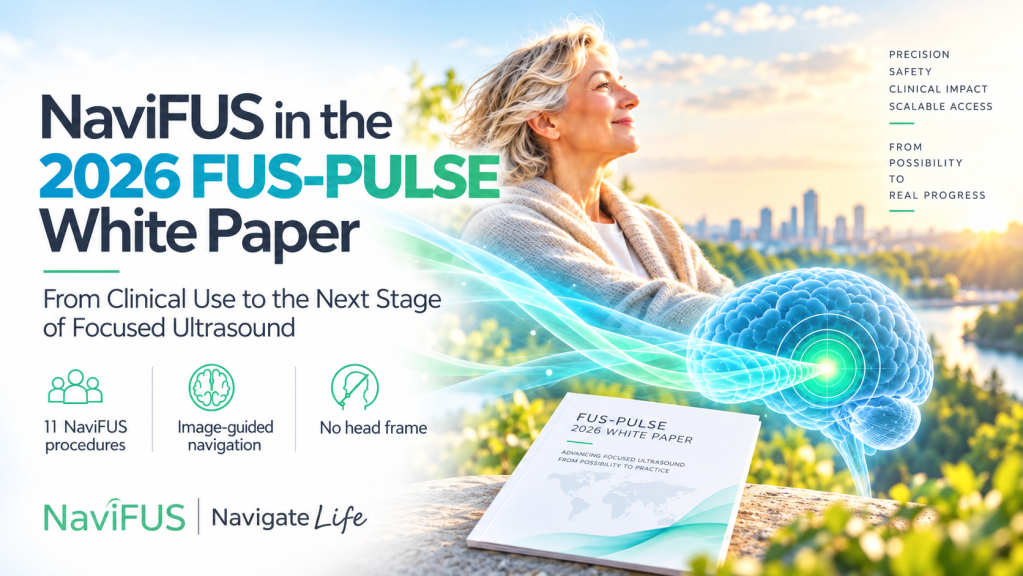
The white paper reports that 11 procedures using NaviFUS were performed in 2025–2026 as part of an open-label dose-escalation study. It also notes a practical workflow difference: NaviFUS uses image-guided navigation and does not require a head frame.
The same section also reports aggregate safety findings from the addiction neuromodulation program. All 11 NaviFUS procedures were reported with no hemorrhage, swelling, or imaging findings.
Together, these details point to an important transition for the field. The question is no longer only whether focused ultrasound neuromodulation is technically possible, but how it can be delivered safely, reliably, and more practically in real clinical settings.
NaviFUS in the Technical Discussion
NaviFUS was also directly represented in a technical discussion on beam localization.
Arthur Lung, Ph.D., Chairman of the Board of NaviFUS, described an approach combining signals from dedicated receivers with a forward model informed by neuronavigation geometry. The white paper notes that accuracy is bounded by the accuracy and resolution of the neuronavigation system itself.
This reflects a broader challenge for the field: not only generating a focused ultrasound beam, but understanding where the energy is delivered and how targeting can be monitored and refined.
The Field Is Moving Toward Scale
A recurring message throughout the 2026 white paper is clear: scalability matters.
The report highlights growing interest in wearable and outpatient device platforms, along with approaches designed for more practical deployment. It also notes that, if focused ultrasound can operate within appropriate safety parameters, the technology could become highly scalable and potentially extend beyond major academic centers.
That direction strongly resonates with the path NaviFUS has been pursuing.
Our focus is not only on what focused ultrasound can do, but on how it can become more practical for clinicians and more accessible to patients.
The field is moving quickly, and for NaviFUS, it is exciting to see our clinical experience and technical approach becoming part of the international conversation shaping what comes next.
Built for the next stage of non-invasive brain therapy.
NaviFUS | Curing disease with sound.
Read the Original Coverage
Focused Ultrasound Foundation
Focused Ultrasound in Psychiatry: Second PULSE Symposium Held in Toronto
https://www.fusfoundation.org/posts/focused-ultrasound-in-psychiatry-second-pulse-symposium-held-in-toronto/
2026 FUS-PULSE White Paper
https://cdn.fusfoundation.org/2026/09/18140448/FUSPULSE_WhitePaper2026.pdf